Nov 2, 2025
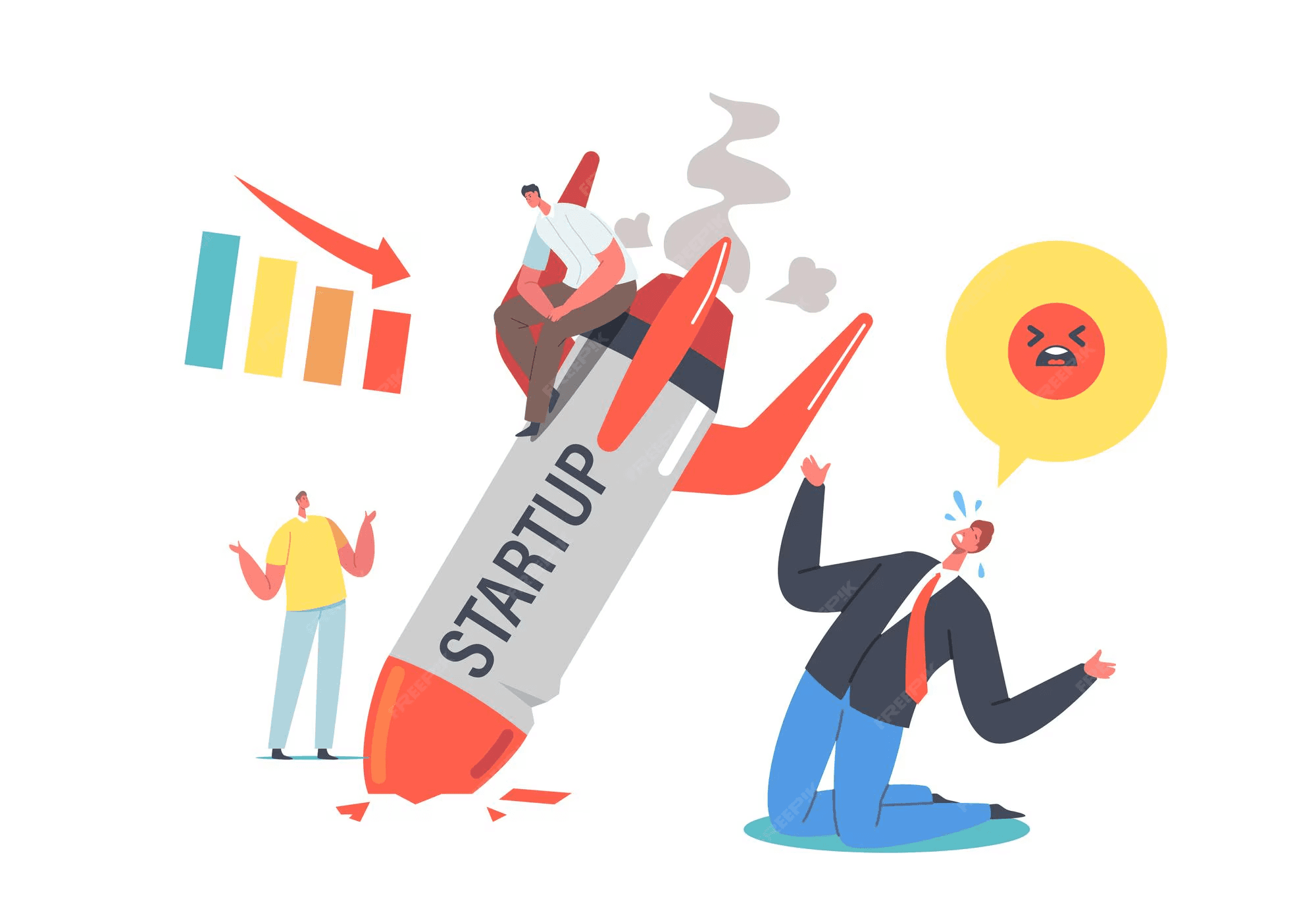
Lessons From Africa's Failed Startups: What the Data Really Reveals
Africa's startup ecosystem celebrates its unicorns and funding milestones, but the companies that fail often teach us more than those that succeed. Between 2014 and 2022, venture activity across Africa expanded steadily, reaching a peak of 781 transactions in 2022 according to Pitchbook data. Yet for every headline-grabbing success, dozens of startups quietly shut down, taking with them millions in investor capital and years of founder effort.
The narrative around African tech failures typically follows a predictable script: regulatory challenges, infrastructure gaps, and funding difficulties. While these factors certainly matter, Zellow's analysis of prominent failures reveals patterns that go deeper than the obvious explanations. Understanding why startups collapse and, more importantly, what those failures signal about ecosystem maturity offers critical insights for founders, investors, and policymakers.
The Funding Cycle That Created Fragility
The boom years between 2014 and 2022 produced unprecedented capital inflows into African startups. More than 500 companies received backing from foreign investors who concentrated their attention on fintech, logistics, agritech, and mobility. These investments improved access to essential services across multiple markets, but they also created an environment where valuations rose rapidly, and competition intensified without corresponding improvements in unit economics.
Observation: This period rewarded speed over sustainability. Startups that could demonstrate rapid user acquisition attracted follow-on funding regardless of whether their business models could generate profits at scale. The implicit assumption that African markets would eventually mirror the high-margin dynamics of Western tech ecosystems proved fundamentally flawed for many business models.
When global interest rates rose sharply in 2023, this fragility became apparent. Africa's total venture capital funding dropped by approximately half, while deal volume decreased by more than 25 per cent. The startups that had built their operations around continuous capital infusions suddenly faced an environment where follow-on funding evaporated. Many discovered too late that their runway assumptions had been based on market conditions that no longer existed.
The Geographic Concentration Risk
Partech Africa reports that in 2024, South Africa, Egypt, Kenya, and Nigeria captured about 70 percent of total equity funding. These countries benefit from large consumer markets, strong entrepreneurial networks, and deeper financial systems. Yet this concentration creates a particular type of failure pattern that receives insufficient attention.
Insight: Startups that achieve initial success in one of the Big Four markets often attempt geographic expansion before fully solving the unit economics challenges in their home market. The assumption that a model working in Lagos will translate directly to Nairobi or Cairo has proven costly. Each market presents distinct regulatory frameworks, payment infrastructure maturity levels, consumer behaviour patterns, and competitive dynamics.
The data shows that most other African countries attracted investment levels below $10 million annually. This isn't just a funding distribution problem; it reflects genuine operational complexity. Startups attempting pan-African strategies discover that the continent functions less like the United States (where state-level differences are manageable) and more like the European Union (where meaningful barriers exist between adjacent markets).
Early-stage pipeline weakness compounds this challenge. Angel funding remains limited, and seed-stage activity declined significantly in 2024. The concentration effect means mature companies attract capital while new ventures face barriers to entry, reducing the long-term diversity and resilience of the ecosystem.
Five Failures That Reveal Systemic Patterns
Wabona: When Content Economics Don't Scale
Wabona entered Africa's video-on-demand market early, securing funding from 88mph and CRE Venture Capital between 2012 and 2015. The company's closure illustrates a recurring challenge in African digital media: content costs that exceed what most consumers can afford to pay.
Analysis: Wabona's failure wasn't simply about "struggling to raise follow-on capital"; rather, it reflected a fundamental mismatch between Western content licensing models and African purchasing power. The company needed to pay international rates for content while competing in markets where monthly entertainment budgets might total less than $5. No amount of scale could bridge that gap using the business model they'd chosen.
This pattern persists today. Startups that import capital-intensive business models from high-income markets without substantially restructuring their economics face similar constraints. The lesson isn't that media businesses can't work in Africa; it's that they require different cost structures and revenue models than their Western counterparts.
Mxit: The Platform Transition Trap
Mxit dominated South African social networking from 2004 through the early 2010s, built specifically for feature phones. When smartphone adoption accelerated, the company failed to transition effectively. WhatsApp and Facebook captured users faster, and Mxit's base declined until operations ceased in 2015.
Strategic assessment: Mxit's failure demonstrates how quickly platform advantages evaporate during technology transitions. The company had solved distribution, user acquisition, and engagement for feature phones. Their engineering talent and product intuition were optimised for constraints that suddenly disappeared.
What makes this particularly instructive is that Mxit saw the transition coming. Smartphone adoption curves were visible years in advance. Yet the company apparently couldn't execute a fast enough rebuild of their technology stack and user experience for the new platform reality. This suggests that knowing what's coming and having the organizational capacity to respond are entirely different challenges.
Afrostream: The Exit Market That Doesn't Exist
Afrostream launched in 2014 with backing from Y Combinator and Orange Digital Ventures, positioning itself as "Netflix for African content." Despite prestigious investors and a compelling positioning, the company shut down in 2017 when funding efforts stalled, and no buyer emerged.
Critical insight: Afrostream's closure revealed a structural weakness in Africa's tech ecosystem that persists today. That is the absence of meaningful acquisition markets. In Silicon Valley, startups that can't achieve profitable scale often get acquired by strategic buyers or larger tech companies. This exit path allows investors to recover capital and successful teams to continue building.
Africa lacks this acquisition infrastructure. When Afrostream needed an exit, no regional media conglomerate, telecommunications company, or tech platform had both the capital and strategic rationale to acquire them. The limited mergers and acquisitions landscape means African startups face binary outcomes: achieve profitable scale or shut down. This makes African venture investing structurally riskier than comparable markets with robust acquisition dynamics.
Lipa Later: When Underwriting Models Break
Lipa Later raised more than $16 million for its buy-now-pay-later model in Kenya between 2018 and 2025. Rising default rates and reduced access to capital eventually forced the company into administration when debt obligations could no longer be met.
Analysis: Lipa Later's trajectory illustrates how credit-based business models face compound risks in African markets. The company needed to solve three simultaneous challenges: accurate credit risk assessment for populations with limited formal credit histories, operational systems that could handle collections at scale, and access to low-cost capital to fund the lending book.
When macroeconomic conditions deteriorated and consumer default rates increased, these three challenges became mutually reinforcing. Higher defaults made refinancing more expensive, which forced the company to tighten credit standards, which reduced revenue and made the unit economics less attractive to new capital providers. Once this cycle began, no clear path existed to break out of it.
The broader lesson for African fintech: Credit models that work during economic expansion can collapse quickly when conditions tighten. Startups building lending or credit businesses must stress-test their models against scenarios that include both rising defaults and restricted capital access simultaneously, precisely the conditions that are most likely during economic downturns.
Okra: When Regulatory Uncertainty Becomes Regulatory Reality
Okra built Nigeria's leading open-banking API between 2019 and 2025, connecting to 18 banks and raising significant capital. Despite strong initial traction, the company faced regulatory delays, currency volatility, and intensifying competition. A pivot to cloud infrastructure failed to gain expected traction, several leaders departed, and operations eventually ceased.
Strategic analysis: Okra's failure is particularly instructive because it occurred in a sector—financial infrastructure—that theoretically should have thrived as Nigeria's digital economy expanded. The company's API technology worked, banks were integrating it, and fintech startups needed exactly what Okra provided.
What killed Okra wasn't a lack of product-market fit in the traditional sense. Instead, the company encountered what I call "regulatory quicksand"—an environment where rules remain unclear long enough that startups exhaust resources before achieving the clarity needed to scale confidently. Banks hesitated to integrate deeply with infrastructure that might require retrofitting if regulations changed. Fintech startups built redundant systems rather than depending entirely on a provider operating in regulatory grey zones.
The cloud pivot appears to have been an attempt to escape this quicksand by moving to a less regulated domain. But pivots consume resources and organisational focus, and executing a major strategic shift while managing a struggling core business rarely succeeds. By the time leadership departures began, the company had likely passed the point where recovery was feasible.
The Pattern Nobody Discusses: Premature Geographic Expansion
Examining these five failures alongside dozens of quieter shutdowns reveals a recurring mistake that receives surprisingly little attention in post-mortems: premature geographic expansion.
Zellow's analysis suggests that African startups face a particularly vicious trap around geographic scaling. Investors pressure companies that achieve traction in one market to expand regionally, both to justify continued funding and to pursue the pan-African narratives that attract international capital. Yet expanding across African markets requires navigating:
Regulatory fragmentation: Each country maintains different licensing requirements, data residency rules, and compliance frameworks. A fintech solution legal in Kenya might require complete restructuring to operate in Nigeria.
Payment infrastructure variation: Mobile money dominance in East Africa, card-based systems in South Africa, and cash dependence in many West African markets mean that payment integration work rarely transfers across borders.
Local partnership requirements: Many markets mandate local partnerships, equity stakes for domestic investors, or operational presence that prevents centralized scaling.
Currency management complexity: Operating across multiple currencies introduces treasury management challenges and foreign exchange risks that startups are poorly equipped to handle.
The data pattern is clear: startups that expand to their second or third market before achieving strong unit economics in their first market face significantly elevated failure risk. The operational complexity of multi-market operations exceeds their organizational capacity while simultaneously diluting focus from solving the fundamental business model challenges.
Insight: The startups that survive aren't necessarily better at geographic expansion; they're better at resisting investor pressure to expand prematurely. They stay in their initial market until they've solved pricing, developed efficient customer acquisition channels, and built operational systems robust enough to replicate. Only then do they add the complexity of new geographies.
What the Failure Data Reveals About Ecosystem Maturity
These patterns collectively suggest that Africa's startup ecosystem is experiencing a predictable maturation process. The early boom years rewarded first movers and concept validation. The current period is filtering out business models that can't survive without continuous capital infusions or that don't adequately account for local market constraints.
Three maturation signals stand out in the failure data:
First, capital efficiency is becoming non-negotiable. The startups shutting down in 2024 and 2025 often raised substantial rounds during easier funding periods. Their failures indicate that the market is no longer willing to fund operations that burn cash without clear paths to profitability. This represents healthy ecosystem development; capital should flow to sustainable models.
Second, local adaptation matters more than international pedigree. Several failed companies had prestigious accelerator backing or successful founders from other markets. Yet these advantages couldn't overcome fundamental mismatches between their business models and African market realities. The ecosystem is learning that what matters most is a deep understanding of local constraints and a willingness to design around them.
Third, the exit market's absence is becoming undeniable. The inability of promising but struggling companies to find acquirers exposes a critical piece of missing infrastructure. Until African tech develops robust acquisition markets, whether through strategic corporate buyers, consolidation plays, or regional tech platforms, the ecosystem will continue to see binary outcomes that make venture investing structurally riskier than it needs to be.
What Should Change (And What Probably Won't)
The Tony Blair Institute for Global Change and other policy organisations have outlined comprehensive reforms: transparent data platforms to improve capital access, regulatory sandboxes to enable innovation, infrastructure investments to reduce operational costs, and pan-African networks to strengthen ecosystem connectivity.
These recommendations are thoughtful and would certainly help if implemented. Zellow's assessment, however, is that expecting coordinated policy reforms across 54 countries with vastly different priorities and institutional capacities is unrealistic in any near-term timeframe.
What's more likely to drive ecosystem improvement is market-driven adaptation. Founders are already learning from these failures. The startups raising capital in 2024 and 2025 demonstrate a more sophisticated understanding of unit economics, more realistic geographic expansion timelines, and more careful regulatory navigation than their predecessors.
Investors are adapting too. The shift toward larger deal sizes and fewer overall transactions reflects greater selectivity. Capital is flowing to proven teams with demonstrated traction rather than interesting concepts with promising early metrics.
The ecosystem's resilience will ultimately depend less on policy coordination and more on whether enough startups can achieve profitable scale to create the acquisition market, provide successful exit data points, and develop the experienced operator talent pool that ecosystems need to mature. These market-driven dynamics typically develop slowly but prove more durable than policy-dependent reforms.
Conclusion: Failure as Foundation
Africa's startup failures aren't signs of ecosystem weakness; rather, they're evidence of market-based filtering that every maturing innovation economy experiences. Silicon Valley's success wasn't built on avoiding failures; it was built on learning from them quickly enough that each generation of founders made different mistakes than the last.
The critical question isn't whether African startups will continue to fail. They will, and they should when their models don't work. The question is whether the ecosystem develops the institutional memory, founder networks, and investor sophistication to ensure that lessons from these failures actually inform the next generation's strategic decisions.
The data from Wabona, Mxit, Afrostream, Lipa Later, and Okra isn't just a chronicle of what went wrong. It's a blueprint for what to avoid and, more importantly, evidence of an ecosystem developing the self-awareness required for sustainable growth. The startups that thrive in Africa's next decade will do so partly because they learned from the companies that came before them, shut down, and left behind valuable lessons about what actually works in these markets.
More Insight from Real Life Users
























Insights that Drive Change
Empowering smarter decisions across business, policy, and research